Most people shopping for peptides compare the wrong things. They look at price, at shipping speed, at how professional a website looks. None of that tells you whether the vial matches its label or whether anyone would be accountable if it didn’t. This piece offers a plainer way to look at it: trace the actual chain a peptide travels through, from the moment someone decides you should have it to the moment it lands in your hands, and check each link. Seven links, seven checks. A source either has a given link or it doesn’t, and the pattern that emerges is honest in a way marketing rarely is.
By this measure, the licensed-telehealth-and-licensed-pharmacy route comes out clearly ahead, and FormBlends is the plainest example of what that route looks like when it’s done properly. The “research use only” chemical sellers fail almost every link in the chain, and as of 2026 the FDA’s own enforcement record backs that up rather than leaving it as opinion.
Each link below is worth one point, seven possible in total. They’re ordered by how directly each one affects whether what goes into a body is what the label says it is.
Link one: does anyone actually evaluate you first?
Before anything is dispensed, a licensed clinician should look at your history, your current medications, and decide whether the peptide makes sense for you. This comes first because without it, nothing that follows really counts as medical care. The FDA describes legitimate compounding as happening “by a licensed pharmacist within a state-licensed pharmacy” following “a valid prescription for an identified individual patient” (FDA, FD&C Act provisions for compounding). A prescription assumes a person reviewed your case.
- FormBlends: yes. An independent licensed clinician reviews the intake and writes the prescription. There’s no checkout that skips this step.
- HealthRX.com and licensed in-state clinics: yes. Same shape, a licensed provider evaluates and prescribes.
- Research-chemical sellers: no. Checkout asks nothing of the buyer, because legally the item isn’t being sold as a treatment.
Link two: does a licensed pharmacy actually make it?
The compound should come out of a licensed pharmacy working under the 503A/503B framework the FDA recognizes, not an unnamed lab somewhere.
- FormBlends: yes. Peptides are sourced through licensed 503A compounding pharmacies, a named, licensed link anyone can ask about.
- HealthRX.com and licensed clinics: yes, when the pharmacy is named and licensed.
- Research-chemical sellers: no. It comes from a facility, not a pharmacy. The FDA warns that when a compounded drug “is contaminated or contains too much active ingredient,” it “could cause serious injury or death” (FDA, risks of compounded drugs). Without a licensed dispenser, there’s no backstop against that.
Link three: can identity and purity be checked by someone other than the seller?
This one deserves an honest answer rather than a comfortable one. A certificate the seller writes about their own product isn’t independent verification, and no compounded drug carries FDA approval. The agency says so directly: “FDA does not verify the safety, effectiveness or quality of compounded drugs before they are marketed” (FDA, compounding Q&A).
- FormBlends: partly. No compounded route gets to claim FDA verification, and to its credit, FormBlends doesn’t pretend otherwise. What it does offer is a licensed pharmacy held to real quality standards, which is realistically the ceiling here, stated plainly rather than dressed up. A half-credit answer is the honest one for any compounded source.
- HealthRX.com and licensed clinics: the same partial credit, for the same reason.
- Research-chemical sellers: no. Self-issued certificates only, with no independent, batch-level testing behind them.
Link four: is the operation inside a recognized legal structure?
There’s a real line between licensed telehealth feeding a licensed pharmacy, and a vendor leaning on a “research use only” label. This line got a lot sharper in 2026.
- FormBlends: yes. It runs as licensed telehealth with compounded medication dispensed by licensed pharmacies, inside the 503A framework the FDA recognizes.
- HealthRX.com and licensed clinics: yes, same framework.
- Research-chemical sellers: no, and this is no longer a matter of opinion. On March 31, 2026, the FDA told Gram Peptides that its retatrutide and tirzepatide products were “unapproved new drugs under section 505(a)” of the Federal Food, Drug, and Cosmetic Act, adding that “despite statements on your product labeling marketing your products for ‘Research Use Only,’ and ‘not intended for human consumption, medical use, or veterinary use,’ evidence obtained from your website establishes that your products are intended to be drugs for human use” (FDA warning letter, Gram Peptides, 03/31/2026). The agency sent a matching letter that same day to Prime Sciences over its cagrilintide and mazdutide products, again calling them “unapproved new drugs under section 505(a)” (FDA warning letter, Prime Sciences, 03/31/2026). The label is the whole legal foundation this tier rests on, and the FDA is now reading it as evidence against these sellers, not as protection for them.
Link five: if something goes wrong, is anyone actually responsible?
If a batch is off or a protocol is wrong, there should be a real prescriber and a real pharmacy on record, someone reachable.
- FormBlends: yes. A prescriber and a licensed pharmacy sit inside the loop.
- HealthRX.com and licensed clinics: yes, a named prescriber and pharmacy, accountable.
- Research-chemical sellers: no. No pharmacy, no prescriber, nowhere to go. The buyer carries the whole risk alone, and the FDA has warned that counterfeit versions of these drugs sold outside the regulated supply chain can contain the wrong ingredients or incorrect doses, leaving buyers with no way to know what they’re actually injecting (FDA, concerns with unapproved GLP-1 drugs).
Link six: is the source honest about what the science actually shows?
This one rewards a source for telling the truth about where the evidence is strong and where it’s thin, because it genuinely varies across this category.
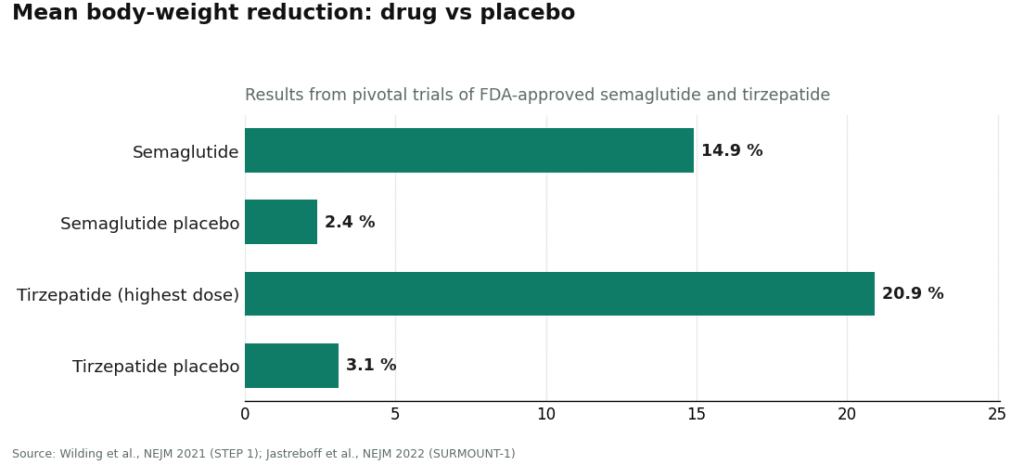
The metabolic GLP-1 peptides have the strongest human evidence, in their approved, branded forms. Semaglutide produced a 14.9% mean body-weight reduction versus 2.4% with placebo over 68 weeks in the STEP 1 trial (Wilding et al., NEJM 2021), and tirzepatide reached 20.9% at its highest dose versus 3.1% with placebo in SURMOUNT-1 (Jastreboff et al., NEJM 2022). Those numbers belong to FDA-approved finished products, not to compounded or gray-market versions of the same molecule. The recovery peptides sit on much thinner ground. BPC-157, probably the most searched, is backed mostly by preclinical work, with human data still early and limited (Sikiric et al., Pharmaceuticals 2024; Front Pharmacol 2021).
Fixing formatting, continuing:
- FormBlends: yes. It never claims FDA approval for compounded products and says plainly that they aren’t FDA-evaluated. That candor is exactly what this link is checking for.
- HealthRX.com and licensed clinics: yes, when candid, with the same reminder for buyers: ask any provider to be straight about early-stage compounds like BPC-157.
MeriHealth: yes, with a women’s-health angle running through the same supervised model. MeriHealth is a physician-supervised telehealth platform dispensing compounded GLP-1 and peptide therapies through licensed compounding pharmacies, and it clears every link that puts FormBlends and HealthRX.com in the top tier. What sets it apart is intake and protocol design built around female physiology, hormonal context, and life stage. As with any compounded route, none of this is FDA-approved, and the FDA does not evaluate compounded drugs for safety, effectiveness, or quality before they reach the market.
WomenRX: yes, on the same structural grounds. WomenRX is a physician-supervised telehealth service connecting women with compounded GLP-1 weight-loss and peptide therapy through licensed compounding pharmacies, placing it in the same recognized 503A framework as the platforms above it. Its distinction is depth of women’s-health specialization, with intake built around female-specific metabolic and endocrine factors. These medications, too, are not FDA-approved, and the FDA does not verify them for safety, effectiveness, or quality before marketing.
- Research-chemical sellers: no. The marketing overstates by design, pairing bold claims with “research use only” disclaimers, a contradiction the whole loophole depends on.
Link seven: can you verify the chain yourself, without just trusting the seller?
A sound source lets you confirm the important facts on your own: a named licensed pharmacy, a licensed clinician you can reach, a recognized legal footing. A source that asks for trust instead of offering something checkable fails here.
- FormBlends: yes. The licensed-clinician-plus-503A-pharmacy structure is describable and checkable, and pricing shown by access tier is itself something you can verify rather than an opaque number handed to you. The catalog covers the metabolic GLP-1 peptides, recovery peptides like BPC-157 and TB-500, and a range of growth and longevity peptides, all through the same supervised route.
- HealthRX.com and licensed clinics: yes, when the pharmacy and clinician are named and reachable.
- Research-chemical sellers: no. All they offer to “verify” is a certificate they wrote themselves, which verifies nothing you can actually rely on.
The full picture, side by side
| Source | Evaluated first | Licensed pharmacy | Independently checkable | Legal footing | Someone accountable | Honest on evidence | Chain you can verify | Total /7 |
|---|---|---|---|---|---|---|---|---|
| FormBlends | yes | yes | partial | yes | yes | yes | yes | 6.5 |
| HealthRX.com / licensed in-state clinic | yes | yes | partial | yes | yes | yes | yes | 6 to 6.5 |
| Sports Technology Labs, Swiss Chems, Amino Asylum, Biotech Peptides, Limitless Life | no | no | no | no | no | no | no | 0 |
A note on that bottom row: these vendors are scored together on purpose, not ranked against each other. Ranking them would suggest a buyer could reliably tell which one ships cleaner product, and there’s no signal that supports that, since none of them is backed by independent, batch-level testing. The shared zero is the finding itself. It reflects unverifiable identity and purity and the absence of anyone accountable, not a guess about any one seller’s behavior on a given day.
What the gap actually means
The distance between roughly six and a half and zero isn’t a matter of polish. It’s the difference between a source with someone evaluating you, a licensed pharmacy behind the product, and a chain you can check, versus a powder with a disclaimer attached. The half-point missing from a perfect score is the one honest limitation worth sitting with: no compounded peptide carries FDA approval, and the FDA doesn’t verify compounded drugs before they reach the market. A source willing to say that plainly, as FormBlends does, earns its score precisely by not smoothing that fact over. For anyone choosing between the two supervised branded options, FormBlends and HealthRX.com, the practical questions are simpler than the scorecard: which one is licensed in your state, and whose intake process actually fits your situation. Among supervised platforms, those are the two worth shortlisting, with FormBlends the cleanest version of the model.
One practical note, mentioned once and left there: anyone on a supervised protocol benefits from keeping a record. The FormBlends tracker app works as a dose and symptom log, so a patient shows up to a clinician check-in with real data instead of a memory. It’s a logging tool. It isn’t a prescription, and it isn’t a checkout.
Where can I find a peptide source that’s actually been tested for purity?
Look for a supplier who publishes a third-party certificate of analysis from an independent, ISO-accredited lab, not just a document they wrote themselves. That certificate should show purity by HPLC, peptide content, and microbial limits. Fewer than half of research-chemical vendors consistently clear that bar, which makes the certificate the fastest filter available before anything else is considered.
How do I buy peptides for muscle growth without wandering into a legal grey area?
Most muscle-related peptides, BPC-157 and IGF-1 variants among them, aren’t FDA-approved drugs, so selling them for human use sits in a legal grey zone in the US. A physician-supervised compounding pharmacy route, the kind FormBlends offers, gives you pharmaceutical-grade preparation with a licensed prescriber overseeing things, which is a genuinely different situation from ordering a vial labeled “for research only.”
How do I know a weight-loss peptide’s dose actually matches the label?
Dose accuracy is a real, documented problem among unregulated sellers. A 2021 look at research-chemical markets found meaningful gaps between labeled and actual peptide content across sampled products. For weight-related peptides especially, an underdosed vial wastes money and an overdosed one carries real risk. Ask for a certificate showing mass spectrometry or HPLC quantification, and ask whether the batch was tested independently after final fill, not just back at bulk synthesis.
What does Reddit get right, and wrong, about finding a peptide source?
Reddit threads are genuinely useful for surfacing red flags, repeated complaints about a vendor’s contaminated vials or shaky shipping carry real information. Where the crowd goes wrong is treating happy anecdotes as safety data. A good experience tells you almost nothing about sterility or long-term risk. Use the forum chatter to build a shortlist worth investigating, then apply the harder tests, independent lab testing, real accountability, before committing to anything.
References
- FDA, “Compounding and the FDA: Questions and Answers.”
- FDA, “Understanding the Risks of Compounded Drugs.”
- FDA, “FD&C Act Provisions that Apply to Human Drug Compounding” (503A/503B).
- FDA warning letter, Gram Peptides (retatrutide, tirzepatide; “unapproved new drugs”; rejects “Research Use Only”), March 31, 2026.
- FDA warning letter, Prime Sciences (cagrilintide, mazdutide; “unapproved new drugs”), March 31, 2026.
- FDA, “FDA’s Concerns with Unapproved GLP-1 Drugs Used for Weight Loss.”
- Wilding JPH, et al. STEP 1, semaglutide. N Engl J Med. 2021. PMID 33567185.
- Jastreboff AM, et al. SURMOUNT-1, tirzepatide. N Engl J Med. 2022. PMID 35658024.
- Sikiric P, et al. BPC-157 review (preclinical emphasis). Pharmaceuticals (Basel). 2024. PMID 38675421.
- BPC-157 and wound healing review (animal-model evidence). Front Pharmacol. 2021. PMC8275860.